miércoles, 14 de marzo de 2012

The Personal, Possessive, Reflexive, Reciprocal, Indefinite, Demostrative, Relative

THE PERSONAL

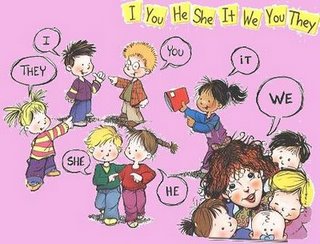
Personal pronouns represent specific people or things. We use them depending on:
number: singular (eg: I) or plural (eg: we)
person: 1st person (eg: I), 2nd person (eg: you) or 3rd person (eg: he)
gender: male (eg: he), female (eg: she) or neuter (eg: it)
case: subject (eg: we) or object (eg: us)

We use personal pronouns in place of the person or people that we are talking about. My name is Josef but when I am talking about myself I almost always use "I" or "me", not "Josef". When I am talking direct to you, I almost always use "you", not your name. When I am talking about another person, say John, I may start with "John" but then use "he" or "him". And so on.

Here are the personal pronouns, followed by some example sentences:

numberpersongenderpersonal pronouns
subjectobject
singular1stmale/femaleIme
2ndmale/femaleyouyou
3rdmalehehim
femalesheher
neuteritit
plural1stmale/femaleweus
2ndmale/femaleyouyou
3rdmale/female/neutertheythem

Examples (in each case, the first example shows a subject pronoun, the second an object pronoun):

I like coffee.
John helped me.
Do you like coffee?
John loves you.
He runs fast.
Did Ram beat him?
She is clever.
Does Mary know her?
It doesn't work.
Can the engineer repair it?
We went home.
Anthony drove us.
Do you need a table for three?
Did John and Mary beat you at doubles?
They played doubles.
John and Mary beat them.


POSSESSIVE


Showing possession in English is a relatively easy matter (believe it or not). By adding an apostrophe and an s we can manage to transform most singular nouns into their possessive form:

the car's front seat

Charles's car

Bartkowski's book

a hard day's work

Possessives & Gerunds

Possessive forms are frequently modifiers for verb forms used as nouns, or gerunds. Using the possessive will affect how we read the sentence. For instance, "I'm worried about Joe running in the park after dark" means that I'm worried about Joe and the fact that he runs in the park after dark (the word "running" is a Present participle modifying Joe). On the other hand, "I'm worried about Joe's running in the park after dark" puts the emphasis on the running that Joe is doing ("running" is a gerund, and "Joe's" modifies that verbal). Usually, almost always in fact, we use the possessive form of a noun or pronoun to modify a gerund. More is involved, however

Possessives versus Adjectival Labels

Don't confuse an adjectival label (sometimes called an "attributive noun") ending in s with the need for a possessive. Sometimes it's not easy to tell which is which. Do you attend a writers'conference or a writers conference? If it's a group of writers attending a conference, you want the plural ending, writers. If the conference actually belongs to the writers, then you'd want the possessive form, writers'. If you can insert another modifer between the -s word and whatever it modifies, you're probably dealing with a possessive. Additional modifiers will also help determine which form to use.

· Patriots quarterback Drew Bledsoe threw three touchdown passes. (plural as modifier)

· The Patriots' [new] quarterback, Drew Bledsoe, threw three touchdown passes. (possessive as modifier]

Possessives of Plurals & Irregular Plurals

Most plural nouns already end in s. To create their possessive, simply add an apostrophe after the s:

The Pepins' house is the big blue one on the corner.

The lions' usual source of water has dried up.

The gases' odors mixed and became nauseating.

The witches' brooms were hidden in the corner.

The babies' beds were all in a row.

With nouns whose plurals are irregular (see Plurals), however, you will need to add an apostrophe followed by an s to create the possessive form.

She plans on opening a women's clothing boutique.

Children's programming is not a high priority.

The geese's food supply was endangered.


REFLEXIVE


A reflexive pronoun is a pronouns that is preceded by the noun, adjective, adverb or pronoun to which it refers (its antecedent) within the same clause. In generative grammar, a reflexive pronoun is an anaphor that must be bound by its antecedent (see binding). In some languages, there is a difference between reflexive and non-reflexive pronouns ; but the exact conditions that determine whether or not something be bound are not yet well defined and depend on the language in question. It depends on the part of the sentence that the pronoun is in.

In English, the function of a reflexive pronoun is among the meanings of the words myself, yourself, thyself (archaic), himself (in some dialects, "hisself"), herself, itself, oneself, ourselves,ourself (as majestic plural), youraelves, and themselves (in some dialects, "theirselves"). In the statements "I see him" and "She sees you", the objects are not the same persons as the subjects, and regular pronouns are used. However, when the person being seen is the same as the person who is seeing, the reflexive pronoun is used: "I seemyself" or "She sees herself".

RECIPROCAL

RESIPROCAL PRONOUNS

We use reciprocal pronouns when each of two or more subjects is acting in the same way towarrds the other. For example: A is talking to B , and is talking to A . So we say:

· A and B are talking to each other.

The action is “ reciprocated”. John talk to Mary and Mary talks to John .I give you a present and you give me a present. The dog bites the cat and the cat bites the dog.

T here are only two reciprocal pronouns, and they are both two words:

1. Each other

2. One another

When we use these reciprocal pronouns:

· there must be two or more people, things or groups involved (so we cannot use reciprocal pronouns with I, you [singular], he/she/it), and

· they must be doing the same thing

examples:

John and Mary love each other.

Peter and David hate each other.

The ten prisoners were all blaming one another.

Both teams played hard against each other.

We gave each other gifts.

Why don't you believe each other?

They can't see each other.

The gangsters were fighting one another.

The boats were bumping against each other in the storm.


INDEFINITE

Using Indefinite Pronouns

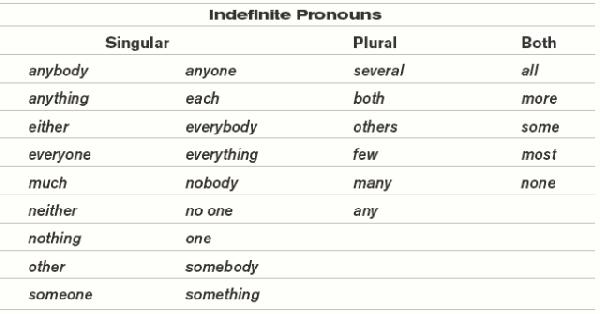
Indefinite pronouns are words which replace nouns without specifying which noun they replace.

Singular: another, anybody, anyone, anything, each, either, everybody, everyone, everything, little, much, neither, nobody, no one, nothing, one, other, somebody, someone, something

Plural: both, few, many, others, several

Singular or Plural: all, any, more, most, none, some

Singular indefinite pronouns take singular verbs or singular personal pronouns.

Correct: Each of the members has one vote.
(The subject, each, is singular. Use has.)

Incorrect: One of the girls gave up their seat.

Correct: One of the girls gave up her seat.
(Her refers to one, which is singular.)

Plural indefinite pronouns take plural verbs or plural personal pronouns.

Correct: A few of the justices were voicing their opposition.
(Few is plural, so are were and their.)

For indefinite pronouns that can be singular or plural, it depends on what the indefinite pronoun refers to.

Correct: All of the people clapped their hands.
(All refers to people, which is plural.)

Correct: All of the newspaper was soaked.
(Here all refers to newspaper, which is singular.)

DEMOSTRATIVE

demonstrate (verb): to show; to indicate; to point to

A demonstrative pronoun represents a thing or things:

near in distance or time (this, these)

far in distance or time (that, those)

near

far

singular

this

that

plural

these

those

Here are some examples with demonstrative pronouns, followed by an illustration:

This tastes good.

Have you seen this?

These are bad times.

Do you like these?

That is beautiful.

Look at that!

Those were the days!

Can you see those?


RELATIVE


Relative Pronouns

A relative pronoun is a pronoun that introduces a relative clause. It is called a "relative" pronoun because it "relates" to the word that it modifies. Here is an example:

  • The person who phoned me last night is my teacher.

In the above example, "who":

  • relates to "person", which it modifies
  • introduces the relative clause "who phoned me last night"

There are five relative pronouns: who, whom, whose, which, that*

Who (subject) and whom (object) are generally only for people. Whose is for possession. Which is for things. That can be used for people** and things and as subject and object in defining relative clauses (clauses that are essential to the sentence and do not simply add extra information).

Function in
the sentence

Reference to

People

Things / concepts

Place

Time

Explanation

Subject

who, that

which, that

Object

(that, who, whom)*

(which, that)*

where

when

what/why

Possessive

whose

whose, of which


jueves, 9 de febrero de 2012

Nouns, Pronoun, Adjectives, Verbs, Adverbs, Preposition, Conjunctions, Interjection

1 NOUNS
Nouns are divided into common nouns and preper noun common nouns rae word for people, animal, place or things.


actor - lawyer - aunt - judger - baby - man - baker - nurse - cook - teacher


cat - goose - cow - hen - dog - horse - dolphin - mouse - duck - parrot


Airport - farm - hospital - hotel - house - island
mall - restaurant - school - stadium


bag - box - kite - lamp - picture - can - radio - train - television - window

Example:
  1. another word for astronaut is spaceman or spacewoman.
  2. There's a little bird in the garden.
  3. Who is your teacher?
  4. Don't eat that rotten apple.
  5. Kate has a lovely doll.
  6. I like reading stories.
  7. My father is a doctor.
  8. Every child has a dictionary.
  9. Rudy hate bananas.
  10. The phone is riging.
  11. Here's a book for you.
Proper Noum

proper nouns are names for particular people, place or things. they always begin whith a capital letter.

Here are some more names of people:
Ali baba - Florence Nightingale - Derek Jeter - Pauline - Johnny Depp - Patrick - Harry Potter

The names of countries and their people are also proper nouns.
American - Egyptian - Indian - Italian - Thai - Japanese - Korean - France

COUNTRY PEOPLE
America Americans
Egypt Egyptians
India Indians
Italy Italians
Korea Koreans
France the French

The names of towns, cities buildings and landmarksare prper nouns.

For example:
Hong Kong
Egypt
the Great Wall of China
the Statue of liberty
Sidney
London
New york

The days of the week and months of the year are proper nouns.


2 PRONOUNS

Apronouns is a word that takes the place of a common noun or a proper noun. There are different kinds of pronouns.

PERSONAL PRONOUNS

The words I, YOU, HE, SHE, IT , WE and THEY are called PERSONAL PRONOUNS. They take the place of nouns and are used as the SUBJECT of the verd in a sentence.

My name is David. I am the youngest in the family
This is my father. he is a teacher.
This Is my mother. she is a lawyer.
I have a brother and two sisters.
They are Peter, Sharon and Jenny.
have a dog. It is a called lucky.
Lucky, you are a good dog.

The words me, you , him, her, it, us and them are also personal pronouns. They also take the place of nouns.
These pronouns are used as the object of the verb in a sentence.

I am sthanding on my head. look at me.
My mother is kind. everybody likes her.
Lisa, I told you to tidy your bed!
Sharon and Jenny! Dad is waiting for you!
Lucky and I are playing in the park . Dad is watching us.
You must not play with the knife. Give itto me.

REFLEXIVE PRONOUNS

The words myself, yourself, himself, herself, itself, ourselves, yourselves, and themselves are called reflexive pronouns.
They refer to the person or animal that os the subject of the verd.

I made this cake myself.
Be careful with the knife. You'll cut yourself.
Michael is looking at himself in the mirro.
Susan has hurt herself.
our cat washes itself after each meal.

3 ADJECTIVES

An andjetive is a describing word . it tells you more about a noun. A n adjective usually appears before the noun it a describes. sometimes, though, the adjective appears after the noun, later in the sentence.

a busy street
a dark corner
a deep sea
a large bed
It is windy.
John's handeriting is very neat.
The sea is roungh.
All the players are very tall.

4 VERDS

Most verds are action words. They tekk you what people, animals or things are doing.

act
bake
bend
burst
buy
close
cook
cross
climb
fall
fly
go
grow
hop
jumo
move
pull
run
shout
sing
sit
slide
stand
start
swim
walk

THE SIMPLE PRESENT TENSE

The simple present tense expresses a general truth or a customany action.

Uncle joe wears glasses.
Ducks love water.
The sun rises in the east.
The children go to school by bus.
Mary enjoys singing.
Peter sometimes lends me his bike.
Cow eat grass.

THE PRESENT PROGRESSIVE TENSE

When do you use the present progressive tense? To talk about action in the present, or things that are still going on or happening now.

I am writing a letter.
Mom is knitting a sweater for sally.
The phone is ringing.
I'm playing chess with my friend.
She's riding a horse.
He's taking a walk in the park.
The man's counting the money.
They are practicing tai chi.
We're rushing to the airoport to meet Mr. Smith.
  • Form the present progressive tense like this:
am + present participle
is + present participle
are + present participle
  • The present participle is the form of a verb ending with -ing. For example:
show + ing = showing
come + ing = coming

  • you have to diubke the last letter of some verbs before you add -ing. For example:
get + ing = getting
nod + ing = nodding
jog + ing = jogging
rob + ing = robbing
stop + ing = stopping
swim + ing = swimming

  • Notice that the verds above are all short verbs of just one syllable.
They all end with a consonant such as b. d, g. m, p, t and heve only one vowel before the consonant.

  • If a verd ends in e, you usually have to drop the e before you add -ing For example:
chase + ing = cahsing
cycle + ing = cycling
drive + ing = driving
smile + ing = smiling

Use the present progessive tense to talk about things you have planned to do, or things that are going to happen in the future. To form the present progressive tense, use am, is and are as helping vers or auxiliary verbs.

When are you taking me to the zoo?
We are having a barbecue later this evening.
I'm starting piano lessons soon
Jim's parents are taking him to texas next week.
My favoryte TV program is starting in a minute.

HAVE AND HAS

The verbs have and has are used to say what people own or possess. they are also used to talk about things that people do or get, such as illnesses. these words are the simple present tense of verb have.

We have breakfast at 7:00 am.
Peter has a sore knee.
He has alot of stamps.
She has long hair.
Our house has large windows.
Have a cookie, if you like.
Dad has a cold.

THE SIMPLE PRESENTE PERFECT TENSE

Use the present perfect tense to talk about happenings in the past that explain or affect the present the present. The verbs have and has are used as " helping" or auxiliary verbs to form the present perfect tense.

Sam has scored two goals.
I've just finished my shower.
Uncle tom has lost his wallet.
John has gone out.
The lees have moved to Ohio
It has not rained for months.

To form the present perfect tense join have or has to past participle of the verb:
Have + Past participle
Has + Past participle

The past participle of a regular verb usually ends in -ed, just like the simple past tense. But the past participles of irregular verbs don't follow this rule.

5 ADVERBS

An abverd is a word that describes a verd. It tells you about an action, or the way something is done.
A lot of adverbs end in -ly

They laughed loudly
The dog is barking fiercely.
Alice skated beautifully
The prince and the princess lived happily ever after.
The birds are singing sweetly.

beautiful beautifully
braave bravely
bright brightly
fierce fiercely
happy happily
heavy heavily
loud loudly
peaceful peacefully
slow slowly
sound soundly
sweet sweetly

Many adverds are made by adding -ly to adjectives.

6 PREPOSITIONS

A preposition is a word that connects one thing with another, showing how they are related.
Some prepositions tell you about preposition or place.

There's abig balloon in the sky.
Jane is jumping into the pool.
The books fell off the shelf.
Dad always keeps his wallet in the drawer.
There is along mirror on the wall.

A preposittion is a usually followed by a noun or pronoun.


7 CONJUNCTIONS

Aconjunction is a linking word such as and, or, but.
Conjunctions are used to connect words or sentences.

The animal is large but timid.
Is this a sheep or a goat'
a cat and its kittens
a builder and his tools
a doctor and a nurse
slow but steady

A conjunction may link two or more than two words or sentences.

The words before, after, as, when, while, until, since, are also conjunctions. They tell when something happens, so they are called conjunctions of time.

Maggie could play the piano before she was five.
I always brush my teeth after i've had my breakfast.
After he began exercising regularly, jerry became healthier.
You have grown taller since I saw you last.
Look boht ways before you cross the street.
Joe listened to music while he was doing his homework.

8 INTERJECTIONS

An interjection is a word that expresses a sudden, strong feeling such as surprise, pain, or pleasure.

Wow!
Goodness!
Oh!
Good!
Oh no!
Hooray!
Thanks!
Help!
Good luck!
Well done!
Gosh!
Hey!
Merry Christmas!
Happy New Year!

Notice that an exclamation point (!) is often used after interjections.