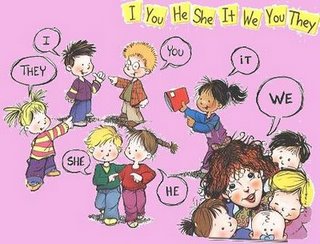
We use personal pronouns in place of the person or people that we are talking about. My name is Josef but when I am talking about myself I almost always use "I" or "me", not "Josef". When I am talking direct to you, I almost always use "you", not your name. When I am talking about another person, say John, I may start with "John" but then use "he" or "him". And so on.
Here are the personal pronouns, followed by some example sentences:
| number | person | gender | personal pronouns | |
| subject | object | |||
| singular | 1st | male/female | I | me |
| 2nd | male/female | you | you | |
| 3rd | male | he | him | |
| female | she | her | ||
| neuter | it | it | ||
| plural | 1st | male/female | we | us |
| 2nd | male/female | you | you | |
| 3rd | male/female/neuter | they | them | |
Examples (in each case, the first example shows a subject pronoun, the second an object pronoun):
I like coffee.John helped me.
Do you like coffee?
John loves you.
He runs fast.
Did Ram beat him?
She is clever.
Does Mary know her?
It doesn't work.
Can the engineer repair it?
We went home.
Anthony drove us.
Do you need a table for three?
Did John and Mary beat you at doubles?
They played doubles.
John and Mary beat them.
Showing possession in English is a relatively easy matter (believe it or not). By adding an apostrophe and an s we can manage to transform most singular nouns into their possessive form:
the car's front seat
Charles's car
Bartkowski's book
a hard day's work
Possessives & Gerunds
Possessive forms are frequently modifiers for verb forms used as nouns, or gerunds. Using the possessive will affect how we read the sentence. For instance, "I'm worried about Joe running in the park after dark" means that I'm worried about Joe and the fact that he runs in the park after dark (the word "running" is a Present participle modifying Joe). On the other hand, "I'm worried about Joe's running in the park after dark" puts the emphasis on the running that Joe is doing ("running" is a gerund, and "Joe's" modifies that verbal). Usually, almost always in fact, we use the possessive form of a noun or pronoun to modify a gerund. More is involved, however
Possessives versus Adjectival Labels
Don't confuse an adjectival label (sometimes called an "attributive noun") ending in s with the need for a possessive. Sometimes it's not easy to tell which is which. Do you attend a writers'conference or a writers conference? If it's a group of writers attending a conference, you want the plural ending, writers. If the conference actually belongs to the writers, then you'd want the possessive form, writers'. If you can insert another modifer between the -s word and whatever it modifies, you're probably dealing with a possessive. Additional modifiers will also help determine which form to use.
· Patriots quarterback Drew Bledsoe threw three touchdown passes. (plural as modifier)
· The Patriots' [new] quarterback, Drew Bledsoe, threw three touchdown passes. (possessive as modifier]
Possessives of Plurals & Irregular Plurals
Most plural nouns already end in s. To create their possessive, simply add an apostrophe after the s:
The Pepins' house is the big blue one on the corner.
The lions' usual source of water has dried up.
The gases' odors mixed and became nauseating.
The witches' brooms were hidden in the corner.
The babies' beds were all in a row.
With nouns whose plurals are irregular (see Plurals), however, you will need to add an apostrophe followed by an s to create the possessive form.
She plans on opening a women's clothing boutique.
Children's programming is not a high priority.
The geese's food supply was endangered.


A reflexive pronoun is a pronouns that is preceded by the noun, adjective, adverb or pronoun to which it refers (its antecedent) within the same clause. In generative grammar, a reflexive pronoun is an anaphor that must be bound by its antecedent (see binding). In some languages, there is a difference between reflexive and non-reflexive pronouns ; but the exact conditions that determine whether or not something be bound are not yet well defined and depend on the language in question. It depends on the part of the sentence that the pronoun is in.
In English, the function of a reflexive pronoun is among the meanings of the words myself, yourself, thyself (archaic), himself (in some dialects, "hisself"), herself, itself, oneself, ourselves,ourself (as majestic plural), youraelves, and themselves (in some dialects, "theirselves"). In the statements "I see him" and "She sees you", the objects are not the same persons as the subjects, and regular pronouns are used. However, when the person being seen is the same as the person who is seeing, the reflexive pronoun is used: "I seemyself" or "She sees herself".
RECIPROCAL
RESIPROCAL PRONOUNS
We use reciprocal pronouns when each of two or more subjects is acting in the same way towarrds the other. For example: A is talking to B , and is talking to A . So we say:
· A and B are talking to each other.
The action is “ reciprocated”. John talk to Mary and Mary talks to John .I give you a present and you give me a present. The dog bites the cat and the cat bites the dog.
T here are only two reciprocal pronouns, and they are both two words:
1. Each other
2. One another
When we use these reciprocal pronouns:
· there must be two or more people, things or groups involved (so we cannot use reciprocal pronouns with I, you [singular], he/she/it), and
· they must be doing the same thing
examples:
John and Mary love each other.
Peter and David hate each other.
The ten prisoners were all blaming one another.
Both teams played hard against each other.
We gave each other gifts.
Why don't you believe each other?
They can't see each other.
The gangsters were fighting one another.
The boats were bumping against each other in the storm.
INDEFINITE
Using Indefinite Pronouns
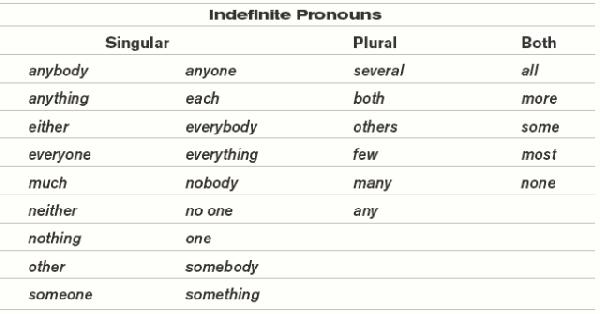
Indefinite pronouns are words which replace nouns without specifying which noun they replace.
Singular: another, anybody, anyone, anything, each, either, everybody, everyone, everything, little, much, neither, nobody, no one, nothing, one, other, somebody, someone, somethingPlural: both, few, many, others, several
Singular or Plural: all, any, more, most, none, some
Singular indefinite pronouns take singular verbs or singular personal pronouns.
Correct: Each of the members has one vote.(The subject, each, is singular. Use has.)Incorrect: One of the girls gave up their seat.
Correct: One of the girls gave up her seat.(Her refers to one, which is singular.)
Plural indefinite pronouns take plural verbs or plural personal pronouns.
Correct: A few of the justices were voicing their opposition.(Few is plural, so are were and their.)
For indefinite pronouns that can be singular or plural, it depends on what the indefinite pronoun refers to.
Correct: All of the people clapped their hands.(All refers to people, which is plural.)Correct: All of the newspaper was soaked.(Here all refers to newspaper, which is singular.)DEMOSTRATIVE
demonstrate (verb): to show; to indicate; to point to
A demonstrative pronoun represents a thing or things:
near in distance or time (this, these)
far in distance or time (that, those)
near
far
singular
this
that
plural
these
those
Here are some examples with demonstrative pronouns, followed by an illustration:
This tastes good.
Have you seen this?
These are bad times.
Do you like these?
That is beautiful.
Look at that!
Those were the days!
Can you see those?

RELATIVE
Relative Pronouns
A relative pronoun is a pronoun that introduces a relative clause. It is called a "relative" pronoun because it "relates" to the word that it modifies. Here is an example:
- The person who phoned me last night is my teacher.
In the above example, "who":
- relates to "person", which it modifies
- introduces the relative clause "who phoned me last night"
There are five relative pronouns: who, whom, whose, which, that*
Who (subject) and whom (object) are generally only for people. Whose is for possession. Which is for things. That can be used for people** and things and as subject and object in defining relative clauses (clauses that are essential to the sentence and do not simply add extra information).
Function in
the sentenceReference to
People
Things / concepts
Place
Time
Explanation
Subject
who, that
which, that
Object
(that, who, whom)*
(which, that)*
where
when
what/why
Possessive
whose
whose, of which

No hay comentarios:
Publicar un comentario